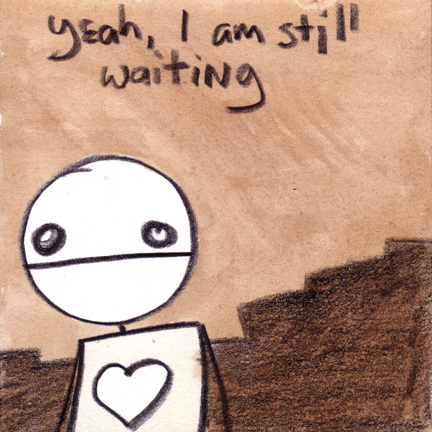
For Ted!

Written by Maria Cecilia C. Dadalt @ Sunday, November 27, 2005
0 Comments & Suggestions


Ciça, chega. Seriously!

Written by Maria Cecilia C. Dadalt @ Saturday, November 26, 2005
0 Comments & Suggestions
Written by Maria Cecilia C. Dadalt @ Thursday, November 24, 2005
0 Comments & Suggestions
Written by Maria Cecilia C. Dadalt @ Thursday, November 24, 2005
0 Comments & Suggestions
 Picture: Loneliness by Maria Cecilia C. Dadalt
“The researchers write that loneliness may have developed early in human evolution as a response by hunter-gathers facing conditions of undernourishment who may have decided not to share their food with their families. By surviving a famine, those early ancestors would be able to propagate during periods of plenty, the researchers theorized. In developing loneliness as an adaptation to survival, these early humans also developed dispositions toward anxiety, hostility, negativity and social avoidance, they said.”
Written by Maria Cecilia C. Dadalt @ Tuesday, November 22, 2005
1 Comments & Suggestions

Written by Maria Cecilia C. Dadalt @ Tuesday, November 22, 2005
1 Comments & Suggestions
Random trivia: " The word ‘set’ has 126 different meanings as a verb, 58 as a noun, and 10 as a participial adjective.
Written by Maria Cecilia C. Dadalt @ Wednesday, November 16, 2005
0 Comments & Suggestions
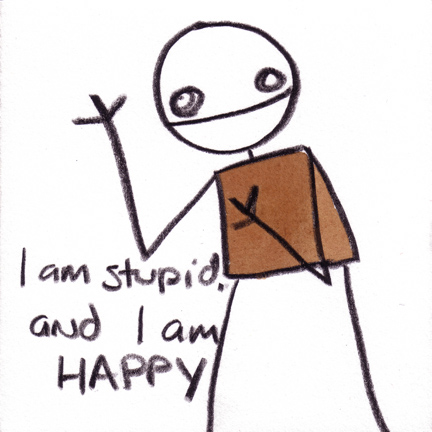
Teams from the Free University in Amsterdam and the University of Chicago looked at data on 8,000 identical, and non-identical, twins.
They found genetics had a significant influence on loneliness.
The researchers, whose study appears in Behavior Genetics, said it showed helping lonely people was not simply a matter of changing their environment.
Loneliness has been linked to heart disease as well as emotional problems, such as anxiety, self-esteem problems and sociability.The researchers suggest that loneliness may stem from prehistoric times, where hunter-gatherers may have deliberately shut themselves away from others so they did not have to share food.
That would have meant they were better nourished and therefore better able to survive and have children.
But they added that the strategy had a downside, in that it also developed dispositions towards anxiety, hostility, negativity and social avoidance.
'Control'
In the study, the twins, who have been surveyed regularly since 1991 when they were aged 13 to 20, were asked if they agreed or disagreed with certain statements, such as "I lose friends very quickly" and "nobody loves me".
The researchers compared the responses of adults in identical, and non-identical, twin pairs, all of whom had been brought up in the same households.
They found less difference in loneliness ratings between identical twins.
They suggest this means that genes play a major role in determining whether or not people will experience the feeling throughout their life.
Professor Dorret Boomsma, who led the study, told the BBC News website: "This kind of knowledge will help because it shows it's not as simple as saying that if you change someone's environment, it will have the same effect on everyone."
But Dr Arthur Cassidy, a psychologist at the Belfast Institute, said people could learn behaviours from their families.
"They may have a very pessimistic outlook and interpret things in a very negative way, so people can learn to become pessimistic and therefore to become lonely.
"But it is possible to unlearn behaviour, using Cognitive Behaviour Therapy (CBT) and psychotherapy."
Story from BBC NEWS:
http://news.bbc.co.uk/go/pr/fr/-/2/hi/health/4426184.stm
Published: 2005/11/11 11:40:29 GMT
Written by Maria Cecilia C. Dadalt @ Sunday, November 13, 2005
0 Comments & Suggestions

Dear Economist,
I do not know whom to turn to. A few months ago I discovered that my wife was having an affair with my boss. I lost both wife and job in quick succession. My wife also took the dog. As I cannot afford my mortgage repayments, I am about to lose my house as well. Betrayed and homeless, I feel very depressed. I have become so desperate as to consider taking my own life. Please help.
- A.W., Dulwich
Dear A.W.,
Don't do anything rash. You are on the verge of making a terrible mistake, albeit one often made by naive practitioners of cost-benefit analysis.
Presumably you are contemplating suicide for the usual reason: a net-present-value calculation suggests that the future benefits of living are outweighed by the future costs. You will have considered the low probability that you will ever love again, the disadvantages of your poor credit record, and the difficulty of securing a new job, especially if applying from no fixed abode. While this cost-benefit analysis may appear to be a rational approach, it neglects advances in the field of real option theory.
Many decisions are irreversible but can be postponed to gather new information. The quintessential example is that of exercising a stock option, which allows the purchase of a share at a particular price. It would seem to a naive investor that an option to buy a share for £5 should be exercised immediately the market price of the share climbs above that level. But this is a mistake: the share may climb much further, or may fall, so while the option remains open there is a value to holding on to it while more information comes in.
Real option theory extends the idea beyond financial investments and into the real world. Apparently rational irreversible decisions to buy houses, build factories, or, indeed, to take one's own life, should often be postponed to gather more information. Your decision to kill yourself would deny you the opportunity to take advantage of any change of fortunes.
The latest economic theory therefore strongly recommends that you postpone your suicide indefinitely. It may be hard to believe, but there is every chance that you will again find true love and a satisfying job.
This week's Economist is Tim Harford, an FT leader writer.
Written by Maria Cecilia C. Dadalt @ Tuesday, November 01, 2005
0 Comments & Suggestions
Written by Maria Cecilia C. Dadalt @ Tuesday, November 01, 2005
0 Comments & Suggestions
|
|
||||||
|---|---|---|---|---|---|---|
| S | M | T | W | T | F | S |
| 1 | 2 | 3 | 4 | |||
| 5 | 6 | 7 | 8 | 9 | 10 | 11 |
| 12 | 13 | 14 | 15 | 16 | 17 | 18 |
| 19 | 20 | 21 | 22 | 23 | 24 | 25 |
| 26 | 27 | 28 | 29 | 30 | 31 | |
Thank you for visiting!
Ciçaland, Narciso e Cia!